
Cataracts are one of the most common causes of gradually worsening vision. A cataract develops when the natural lens inside the eye becomes cloudy, causing vision to become blurry, hazy or less clear. In the early stages, cataracts may not interfere significantly with daily life, so surgery may not be necessary immediately. But how do you know when cataract surgery is needed? The answer is not based only on the size or appearance of the cataract. The right cataract surgery timing depends on how much the cataract is affecting your vision, daily activities, safety, work and overall quality of life. An eye specialist can evaluate your eyes and discuss whether monitoring, updated glasses or cataract operation should be considered. Cataract surgery is currently the definitive treatment for removing a cataract. During the procedure, the cloudy natural lens is removed and replaced with an artificial intraocular lens (IOL). If you have been diagnosed with cataract and are wondering whether it is time to consider surgery, this complete guide will help you understand the important factors.
What Is a Cataract?
A cataract is a cloudy area that develops in the natural lens of the eye. The lens normally helps focus light onto the retina so that you can see clearly. As the lens becomes cloudy, light does not pass through it normally. This can gradually affect the quality and clarity of vision. Common cataract-related vision changes include:
- Blurry or cloudy vision
- Difficulty seeing at night
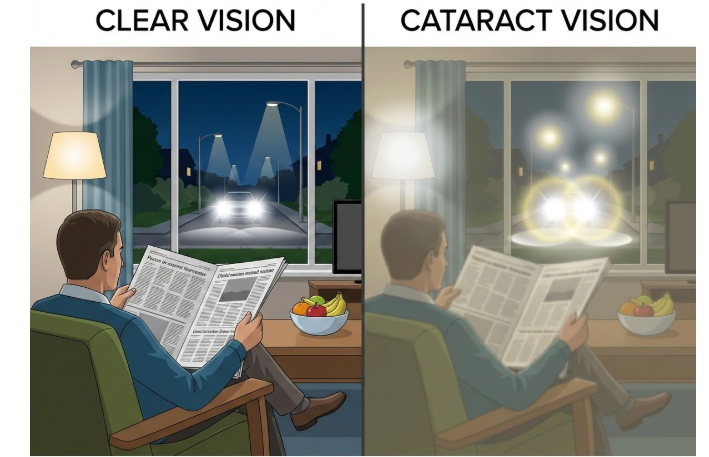
- Glare from headlights and bright lights
- Halos around lights
- Faded or less vibrant colors
- Difficulty reading
- Frequent changes in glasses prescription
- Double or ghost images in some cases
- Difficulty performing everyday activities
Cataracts commonly develop with age, although they can also occur because of factors such as eye injury, certain medical conditions, medications or previous eye surgery.
When Is Cataract Surgery Needed?

One of the most important questions patients ask is whether cataract surgery should be performed as soon as a cataract is diagnosed. Not necessarily. A cataract does not automatically mean that you need immediate surgery. If your vision is still adequate for your daily activities and the cataract is not significantly affecting your quality of life, your eye specialist may recommend monitoring it for some time. Cataract surgery generally becomes a consideration when the cataract starts affecting your ability to perform activities that are important to you, such as:
- Reading
- Driving
- Watching television
- Working
- Using a computer or mobile phone
- Recognizing faces
- Moving around safely
- Performing household activities
- Enjoying hobbies
The National Eye Institute notes that doctors commonly recommend cataract surgery when vision loss interferes with everyday activities such as reading, driving or watching TV. Therefore, cataract surgery timing is highly individual.
10 Signs That It May Be Time to Consider Cataract Surgery
1. Your Vision Is Affecting Everyday Activities
The most important consideration is whether cataract-related vision changes are interfering with your normal life. For example, you may find that reading has become difficult, you need brighter lighting, or you struggle to recognize people from a distance. If these problems are becoming frequent, an eye examination can help determine whether the cataract is responsible.
2. You Are Having Difficulty Driving
Night driving can become particularly challenging with cataracts. Headlights and streetlights may appear excessively bright, and glare or halos may make it harder to see clearly. If you are avoiding driving at night because your vision has become uncomfortable or unsafe, discuss your symptoms with an ophthalmologist.
3. New Glasses Are No Longer Helping Enough
In the early stages, updating your glasses prescription may temporarily improve vision. However, as cataracts progress, changing the prescription may no longer provide the clarity you need. If your vision remains cloudy or hazy despite an appropriate glasses prescription, your doctor may evaluate whether cataract surgery should be considered.
4. Glare and Halos Are Becoming a Problem
Cataracts can cause increased sensitivity to bright lights and make headlights, lamps or sunlight appear uncomfortable. You may also notice halos around light sources. These symptoms can interfere with driving and other activities, particularly in low-light environments.
5. Colors Appear Faded
A cataract can make colors appear less bright or vibrant. Some people describe the world as looking yellowish, dull or less colorful compared with before. This gradual change may be difficult to notice because it usually develops slowly.
6. Reading Has Become Increasingly Difficult
If you need significantly brighter lighting, larger text or frequent breaks while reading, cataract-related changes may be contributing to the problem. An eye examination can determine whether the cataract is responsible or whether another vision condition is involved.
7. Your Vision Is Affecting Your Work
For people who depend heavily on their vision for professional tasks, even moderate visual changes can become frustrating. Computer work, detailed tasks, driving for work or working in low-light environments may become more difficult. If your cataract is affecting your professional activities, discuss your options with your eye specialist.
8. You Are Avoiding Activities You Enjoy
Sometimes the clearest sign that cataract treatment needs to be discussed is a change in lifestyle. You may stop reading, watching movies, traveling, driving, sewing, playing certain games or participating in outdoor activities because your vision is no longer comfortable. Your quality of life matters when discussing cataract surgery timing.
9. Your Eye Doctor Finds Significant Vision Changes
Your decision should not be based only on symptoms. During an eye examination, your doctor can assess the cataract and check for other conditions that could also be affecting your vision. A dilated eye examination can help detect cataracts as well as other eye problems.
10. Another Eye Condition Requires Better Access to the Back of the Eye
In some situations, a cataract may need to be removed even when it is not the only reason for vision problems. For example, removing a cataract can allow the doctor to better examine the back of the eye when monitoring certain retinal conditions. The National Eye Institute notes that cataract removal may sometimes be recommended to allow doctors to see and manage other eye conditions.
Does Every Cataract Need Surgery?
No. A person can have a cataract without immediately needing a cataract operation. If the cataract is mild and vision remains satisfactory, the doctor may recommend regular monitoring. In the early stages, practical measures such as better lighting, anti-glare sunglasses or an updated glasses prescription may help with certain visual difficulties. However, these measures do not remove the cataract itself. When the cataract begins to significantly interfere with vision and daily activities, surgery may become the appropriate treatment option.
Can Cataract Surgery Be Delayed?
In many cases, cataract surgery does not need to be performed immediately after diagnosis. There is no universal rule that says a cataract must be operated on at a particular age or at a specific level of visual acuity. Your doctor will consider:
- Your vision
- Your symptoms
- Your lifestyle
- Your occupation
- Your daily activities
- Other eye conditions
- Overall eye health
- Your personal goals and expectations
The NEI states that most people do not need to rush into cataract surgery and that waiting usually does not harm the eyes or make later surgery more difficult. However, delaying an evaluation is different from delaying surgery after a professional assessment. If your vision is progressively getting worse, regular eye examinations are important.
Is There a “Right Age” for Cataract Surgery?
There is no single age at which everyone should undergo cataract surgery. Cataracts are often age-related, but people can develop them at different ages and with different rates of progression. Therefore, the decision should be based more on visual function and individual circumstances than age alone. For example, one person may have a cataract that is present but causes minimal problems, while another person may experience significant difficulty with reading or driving. That is why an eye specialist should assess each patient individually.
What Happens During a Cataract Operation?
Modern cataract surgery involves removing the cloudy natural lens and replacing it with an artificial intraocular lens, commonly called an IOL.
Step 1: Detailed Eye Evaluation
Before surgery, your ophthalmologist performs appropriate eye examinations and measurements. These measurements help determine the appropriate IOL and evaluate the overall condition of the eye.
Step 2: Preparing the Eye
The eye is prepared for the procedure, and numbing medication is used so that the surgery can be performed comfortably.
Step 3: Removing the Cloudy Lens
The surgeon uses specialized instruments to remove the cataractous natural lens.
Step 4: Implanting the IOL
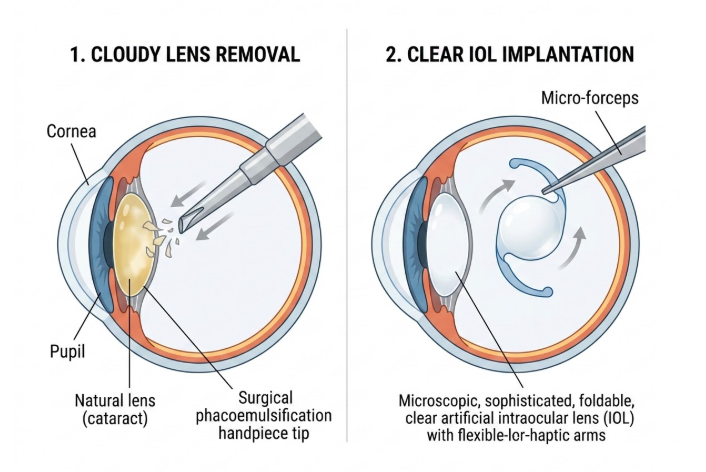
An artificial intraocular lens is placed inside the eye to replace the focusing function of the natural lens.
Step 5: Post-Surgery Care
After surgery, prescribed eye drops and follow-up examinations help monitor healing. Your ophthalmologist will provide individual instructions about protecting the eye and returning to normal activities.
What Is an Intraocular Lens (IOL)?
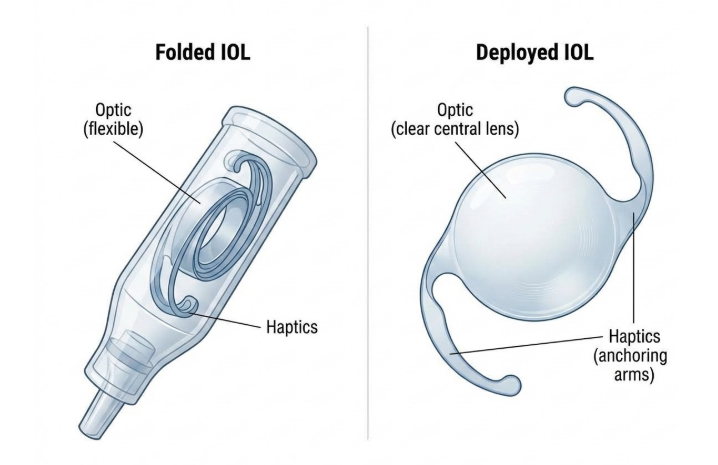
An intraocular lens is an artificial lens implanted inside the eye during cataract surgery. Different IOL options are available, and the appropriate choice depends on factors such as your eye measurements, visual needs, lifestyle and other eye conditions. Your doctor can discuss the available lens options and explain which choices may be appropriate for you. The goal is not simply to remove the cataract but to plan treatment according to the individual patient’s visual requirements.
How Do Doctors Decide the Right Cataract Surgery Timing?
Cataract surgery timing is based on a combination of clinical findings and your experience of vision. Your ophthalmologist may consider:
Visual Function
How clearly you can see and how your vision affects daily activities.
Cataract Development
The appearance and severity of the cataract.
Lifestyle Requirements
Whether you drive, work, read extensively or have visually demanding hobbies.
Other Eye Conditions
Glaucoma, retinal conditions, corneal problems and other eye diseases may influence treatment planning.
Personal Expectations
Your doctor should understand what you want to achieve from cataract treatment. This is why two people with apparently similar cataracts may receive different recommendations.
Cataract Surgery vs Waiting: What Should You Consider?
| Factor | Monitoring the Cataract | Considering Surgery |
| Vision | Still adequate | Increasingly reduced |
| Daily activities | Mostly unaffected | Becoming difficult |
| Reading | Comfortable | Increasingly difficult |
| Night driving | Usually manageable | Glare/night vision problems |
| Glasses | May still help | May no longer provide enough clarity |
| Lifestyle | Little disruption | Activities may be restricted |
| Treatment | Regular monitoring | Surgical evaluation |
This table is a general guide, not a substitute for an eye examination.
What Are the Benefits of Cataract Surgery?
When cataract-related vision loss is the reason for surgery, cataract removal can improve the clarity of vision. Potential benefits may include:
- Clearer vision
- Improved ability to perform daily activities
- Better visual quality
- Improved ability to read or watch television
- Reduced problems caused by cataract-related glare
- Greater independence in daily activities
The outcome depends on the cataract and the health of other parts of the eye. Cataract surgery cannot necessarily restore vision lost because of unrelated eye diseases. The NEI reports that about 9 out of 10 people undergoing cataract surgery see better afterward, although vision may initially be blurry while the eye heals.
Is Cataract Surgery Safe?
Cataract surgery is a commonly performed procedure and is generally considered safe and effective, but no surgery is completely risk-free. Possible complications can include:
- Infection
- Bleeding
- Swelling
- Changes in eye pressure
- Retinal detachment
- Double vision
- Vision loss
- Posterior capsule opacification, sometimes called a secondary cataract
Your ophthalmologist should explain the potential benefits, limitations and risks relevant to your individual case.
What Is Recovery Like After Cataract Surgery?

Recovery varies from person to person. Your eye may initially feel itchy, uncomfortable or sensitive to light. Vision may also be blurry during the early recovery period. Your eye may initially feel itchy, uncomfortable or sensitive to light. Vision may also be blurry during the early recovery period. Follow-up appointments are important because they allow the ophthalmologist to monitor recovery and identify complications early. You should follow your surgeon’s specific instructions regarding:
- Eye drops
- Eye protection
- Physical activity
- Driving
- Swimming
- Rubbing or touching the eye
- Follow-up appointments
Can Cataracts Come Back After Surgery?
The original cataract does not grow back because the cloudy natural lens has been removed. However, some patients may later develop posterior capsule opacification (PCO), commonly referred to as a secondary cataract or after-cataract. This can cause vision to become cloudy again. PCO can generally be treated using a YAG laser procedure rather than repeating the original cataract surgery.
When Should You Book a Cataract Consultation?
Consider scheduling an eye examination if you notice:
- Increasingly blurry vision
- Difficulty driving at night
- Glare or halos
- Faded colors
- Difficulty reading
- Frequent changes in glasses prescription
- Vision that interferes with work
- Difficulty performing normal activities
- A previously diagnosed cataract that is getting worse
Remember that these symptoms can also occur with other eye conditions, so an examination is important before deciding that cataract surgery is necessary.
Questions to Ask Your Eye Doctor Before Cataract Surgery
If your doctor recommends a cataract operation, consider asking:
- How much is the cataract affecting my vision?
- Is cataract surgery recommended now or can I monitor it?
- What are my treatment options?
- What type of IOL may be suitable for me?
- Do I have any other eye conditions?
- What should I expect during recovery?
- When can I return to normal activities?
- What are the potential risks in my particular case?
- Will I still need glasses after surgery?
- What follow-up appointments will I need?
Having a clear discussion with your ophthalmologist can help you understand the treatment plan and make an informed decision.
Final Takeaway: When Is Cataract Surgery Needed?
The decision to undergo cataract surgery should not be based only on your age or the fact that a cataract has been diagnosed. The most important question is: “Is my cataract affecting the way I live, work and see?”
If blurry vision, glare, night-vision problems, faded colors or difficulty reading and driving are beginning to interfere with your daily activities, it may be time to discuss cataract surgery with an ophthalmologist. There is also no need to rush into surgery simply because a cataract has been detected. A comprehensive eye examination can help determine whether you should continue monitoring the cataract, update your glasses or begin planning for surgery.