
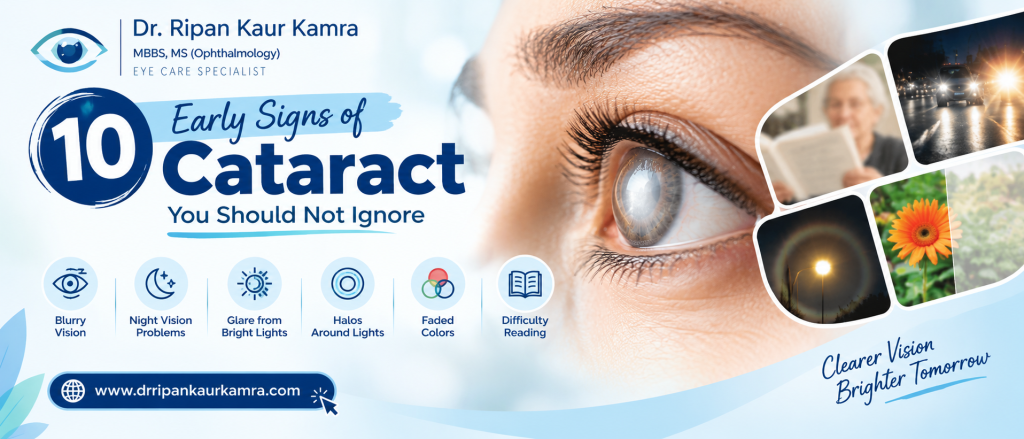
Cataracts are a common eye condition that can gradually affect the clarity of your vision. They develop when the normally transparent lens inside the eye becomes cloudy, making it harder for light to pass through and form a clear image on the retina.One of the biggest challenges with cataracts is that they often develop slowly. You may not notice a major change in your eyesight at first. Instead, small changes can appear over time—such as blurry vision, difficulty seeing at night, glare from headlights, or colors appearing less bright. These changes are easy to dismiss as normal aging or simply a need for new glasses. However, recognizing the early cataract symptoms can help you arrange an eye examination before vision problems begin interfering with your daily activities. In this article, we discuss 10 signs of cataract you should not ignore, what they can feel like, when you should see an eye specialist, and how cataracts are evaluated and treated.
What Is a Cataract?
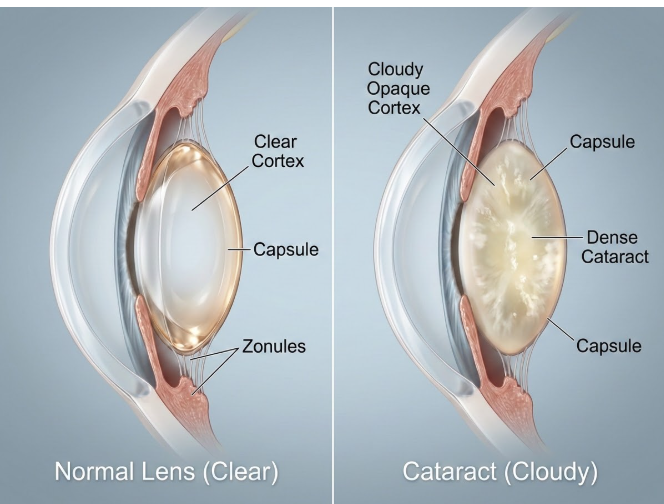
A cataract occurs when the natural lens inside the eye becomes cloudy. The eye’s natural lens normally helps focus incoming light onto the retina. When the lens becomes cloudy, light may be scattered instead of being focused clearly. As a result, vision can gradually become:
- Blurry
- Hazy
- Less colorful
- More sensitive to bright light
- More difficult in low-light conditions
Cataracts are often associated with aging, but they can also develop due to other factors such as previous eye injury, certain medications, smoking, medical conditions, or previous eye surgery. Because cataracts can progress gradually, knowing the signs of cataract can help you recognize when it is time to get your eyes checked.
10 Early Signs of Cataract You Should Not Ignore
1. Blurry or Hazy Vision

One of the most noticeable cataract symptoms is a gradual loss of visual clarity. Objects may appear less sharp than before, almost as though you are looking through a thin layer of fog. You may still be able to see, but fine details can become harder to distinguish. You may notice:
- Letters looking less sharp
- Faces appearing slightly unclear
- Difficulty seeing distant objects
- Hazy vision while watching television
- Increasing difficulty recognizing details
If your vision remains blurry despite using your usual glasses, it is worth arranging a comprehensive eye examination.
Why You Should Not Ignore It
Blurry vision can have many causes, including refractive errors, dry eyes, retinal problems and other eye conditions. Assuming that it is simply a glasses problem could delay appropriate diagnosis.
2. Increasing Difficulty Seeing at Night
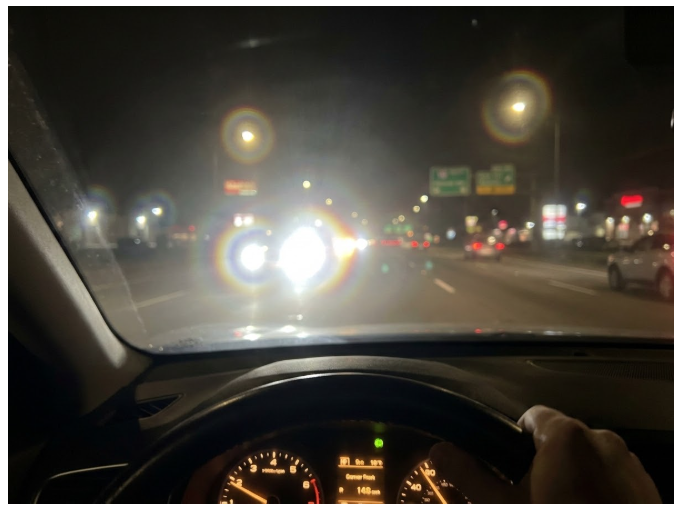
Night vision can become challenging for some people with developing cataracts. You may find it harder to see clearly in dim environments or while driving after sunset. Objects that were previously easy to see may appear less distinct. You might experience:
- Difficulty reading road signs
- Reduced confidence while driving at night
- Trouble seeing in poorly lit rooms
- Difficulty identifying objects in darkness
Why It Matters
Reduced night vision can affect safety, particularly while driving. If nighttime vision has noticeably changed, an eye examination can help determine whether cataracts or another condition is responsible.
3. Glare From Headlights and Bright Lights
Another possible early warning sign is increased glare. Bright light sources may appear unusually intense or uncomfortable. Headlights from approaching vehicles can become particularly bothersome. You may experience glare from:
- Car headlights
- Sunlight
- LED lights
- Streetlights
- Bright indoor lighting
This can make certain everyday situations uncomfortable, especially at night.
Cataracts and Light Scattering
A cloudy lens can scatter light inside the eye. This may contribute to visual disturbances such as glare. However, glare can occur for other reasons as well, so persistent symptoms should be evaluated professionally.
4. Halos Around Lights
Do lights sometimes appear to have a ring or glow around them? Seeing halos around lights can be one of the early cataract symptoms noticed by some people. For example, a streetlight or vehicle headlight may appear surrounded by a circular glow. Halos can become especially noticeable in darker surroundings because the contrast between the bright light and surrounding darkness is greater.
Don’t Self-Diagnose
Halos are not specific to cataracts. They can occur with several eye conditions or vision-related problems. If this symptom is new or becoming more frequent, an eye examination is recommended.
5. Colors Look Faded or Less Bright
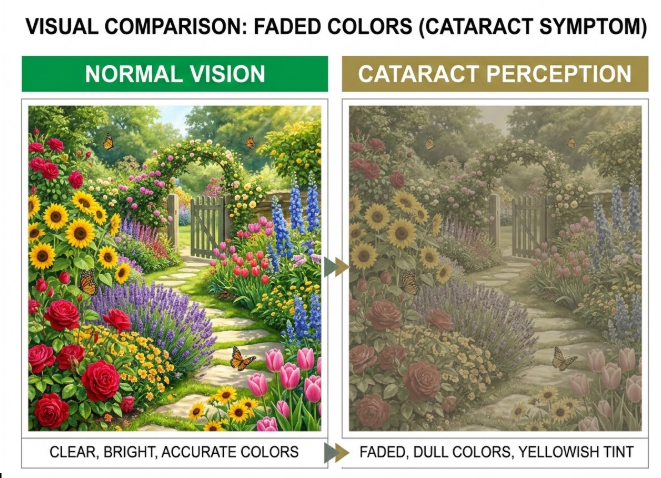
A less obvious sign of cataract is a gradual change in how colors appear. You may feel that:
- White objects look slightly yellow
- Bright colors appear dull
- Clothes seem less vibrant
- Photographs appear less colorful
- Everything seems to have a slightly faded appearance
Because the change develops slowly, many people do not recognize it immediately.
A Simple Clue
If someone else describes a color as bright or vivid but it appears noticeably dull to you, this may be worth discussing with an eye specialist—particularly if it occurs alongside other visual changes.
6. You Need Frequent Changes to Your Glasses
Have you recently needed to change your glasses prescription more often than usual? Changes in the eye’s natural lens can alter the way it focuses light. As cataract develops, some people may notice changes in their prescription. You may find that:
- Your current glasses no longer provide the same clarity.
- Your prescription seems to change repeatedly.
- Vision improves after a new prescription but becomes less clear again later.
- Your distance or near vision changes unexpectedly.
Frequent prescription changes do not automatically mean cataracts. They can have other causes, but they are a good reason to have your eyes examined.
7. Reading Small Print Becomes More Difficult
Another early warning sign can be difficulty with fine details. You may notice that reading:
- Books
- Newspapers
- Phone messages
- Medicine labels
- Menus
- Product packaging
requires more effort than before. You might need brighter lighting or hold reading material closer to your face.
Cataracts or Normal Aging?
Difficulty reading small print is common with age-related changes such as presbyopia. Therefore, it does not necessarily indicate cataracts. However, if reading has become significantly more difficult or your vision is also blurry, hazy or affected by glare, a complete eye examination can help identify the cause.
8. Double Vision or Ghost Images in One Eye
Some people with lens changes may notice a second, faint image alongside an object. This may look like:
- A shadow beside letters
- A duplicate outline around an object
- A ghost image when looking at lights
- Difficulty getting a single sharp image
Double vision can have many causes, and the type of double vision matters.
When to Get Checked
New or persistent double vision should not be ignored. It is important to have an eye specialist determine whether the problem is related to the lens, eye alignment, nerves, or another condition.
9. Everyday Activities Become More Difficult
Sometimes the earliest clue is not a particular visual symptom but a change in what you can comfortably do. You may begin struggling with activities such as:
- Driving
- Reading
- Sewing
- Using a computer
- Watching television
- Cooking
- Recognizing people from a distance
- Walking safely in dim lighting
You may find yourself increasing the brightness of your phone or switching on additional lights.
Your Daily Life Is an Important Indicator
A cataract does not necessarily need treatment immediately after it is detected. What matters is how much the vision problem is affecting your everyday life. If your visual difficulties are becoming noticeable, discuss them with an eye specialist.
10. Your Overall Vision Is Gradually Getting Worse
Perhaps the most important warning sign is a progressive decline in vision. At first, you might notice only mild blurry vision. Later, you may experience several symptoms together:
- Blurry or hazy vision
- Night vision difficulties
- Glare
- Halos
- Faded colors
- Difficulty reading
- Frequent prescription changes
Because cataracts generally develop gradually, you may adapt to the changes without realizing how much your vision has changed. A noticeable or continuing decline in vision deserves professional evaluation.
Why Early Cataract Symptoms Are Often Ignored
One reason cataracts can go unnoticed is that they usually do not cause sudden dramatic symptoms. Instead, vision may change little by little. You might think:
“My glasses are old.”
“I just need brighter light.”
“Night driving is difficult because I’m getting older.”
“My eyes are tired.”
These assumptions may sometimes be correct, but they should not replace an eye examination. A gradual change in eyesight can also be caused by conditions other than cataracts. Early evaluation helps identify the actual problem.
What Causes Cataracts?
Age-related changes are a major reason cataracts develop, but several factors may increase the risk. These can include:
Age
The likelihood of developing cataracts increases with age.
Family History
Having close family members with cataracts may increase your risk.
Eye Injury
Previous trauma to the eye can contribute to cataract formation.
Certain Medications
Long-term use of some medications, particularly corticosteroids, can be associated with cataract development.
Smoking
Smoking is associated with an increased risk of cataracts.
Medical Conditions
Some medical conditions can increase the risk of developing cataracts.
UV Exposure
Long-term exposure to ultraviolet radiation may contribute to cataract development. Not everyone with these risk factors will develop cataracts, but awareness can encourage timely eye care.
How Are Cataracts Diagnosed?
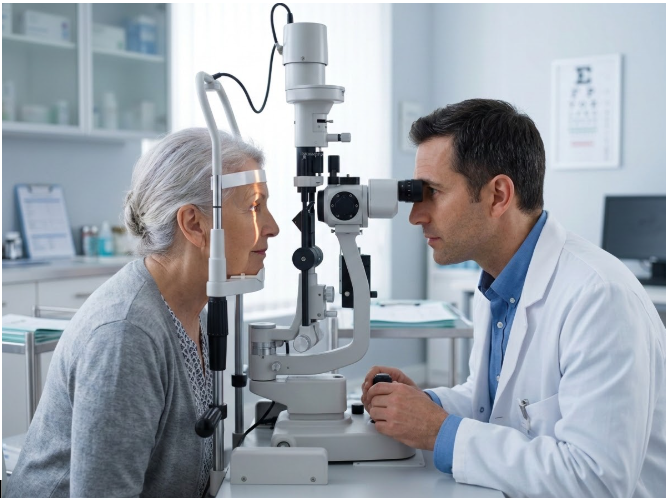
If you notice cataract symptoms, an eye specialist can perform a comprehensive eye examination. The evaluation may include several tests.
Visual Acuity Test
This checks how clearly you can see at different distances.
Slit-Lamp Examination
A slit lamp provides a magnified view of the structures at the front of the eye and allows the lens to be examined closely.
Dilated Eye Examination
The pupils may be dilated so the specialist can examine the lens, retina and optic nerve more thoroughly.
Refraction
A refraction test helps determine whether changes in your glasses prescription are contributing to your visual problems. The examination also helps rule out other eye diseases that can cause similar symptoms.
When Should You See an Eye Specialist?
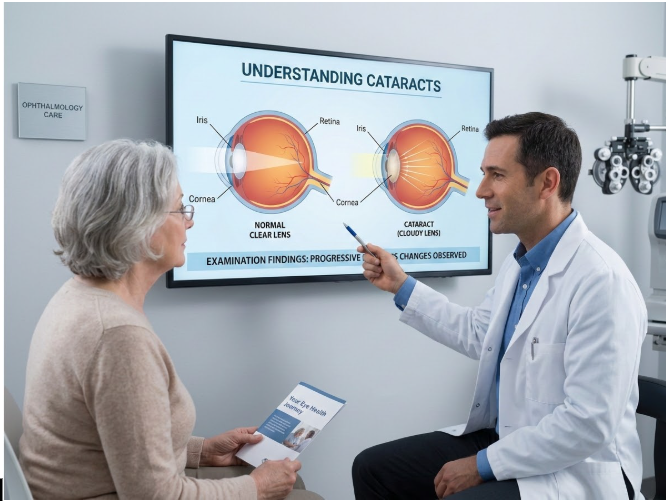
You should consider scheduling an eye examination if you notice:
- Persistent blurry vision
- Difficulty seeing at night
- Increasing glare
- Halos around lights
- Colors becoming less vibrant
- Frequent changes in glasses prescription
- Difficulty reading
- Progressive changes in vision
- Problems performing normal daily activities
Regular eye examinations are also important even if you do not currently have obvious cataract symptoms.
Can Early Cataracts Be Treated Without Surgery?
In the early stages, your eye specialist may recommend monitoring the cataract and addressing vision changes with updated glasses or improved lighting. However, these measures do not remove the cataract itself. When a cataract becomes sufficiently advanced to interfere with everyday activities, cataract surgery may be considered. The decision is based on your symptoms, visual needs, eye health and the assessment of your eye specialist.
When Is Cataract Surgery Recommended?
Cataract surgery may be considered when the cloudy lens is significantly affecting your ability to perform activities that are important to you. These may include:
- Reading
- Driving
- Working
- Watching television
- Recognizing faces
- Using digital devices
- Performing household activities
The decision should be individualized rather than based only on the appearance or age of the cataract.
Can Cataracts Be Prevented?
Not all cataracts can be prevented, particularly those related to aging. However, several healthy habits may support long-term eye health.
Protect Your Eyes From UV Radiation
Use appropriate UV-protective eyewear when spending extended periods outdoors.
Avoid Smoking
Not smoking can reduce several health risks, including factors associated with cataract development.
Maintain a Healthy Lifestyle
A balanced diet and healthy lifestyle support overall health.
Protect Your Eyes From Injury
Use suitable protective eyewear during activities where eye injury is possible.
Schedule Regular Eye Examinations
Regular eye checks can help detect cataracts and other eye conditions before vision problems become severe.
Cataract Symptoms vs Other Eye Problems
It is important to remember that cataract symptoms are not unique to cataracts. For example:
| Symptom | Possible Causes |
| Blurry vision | Cataract, refractive error, dry eye, retinal conditions and others |
| Night vision difficulty | Cataract, refractive problems and other eye conditions |
| Glare | Cataract, corneal problems and other conditions |
| Halos | Cataract, refractive issues and certain eye conditions |
| Faded colors | Cataract and other visual/retinal conditions |
| Double vision | Eye alignment, nerve, lens and other problems |
This is why online information should not be used for self-diagnosis. A comprehensive eye examination is the safest way to understand what is causing your symptoms.
What Happens If Cataract Symptoms Are Ignored?
A cataract may continue to progress over time. As vision becomes less clear, activities that were once easy can require more effort. You may start avoiding nighttime driving, need more light for reading, or find it harder to recognize details. As vision becomes less clear, activities that were once easy can require more effort. You may start avoiding nighttime driving, need more light for reading, or find it harder to recognize details. Don’t wait for your vision to become severely impaired before getting it checked.
Key Takeaway: Don’t Ignore the Signs of Cataract
The early stages of cataract can be subtle, but your eyes may provide several warning signs. The 10 early signs of cataract discussed in this article are:
- Blurry or hazy vision
- Difficulty seeing at night
- Increased glare from bright lights
- Halos around lights
- Faded or less vibrant colors
- Frequent changes in glasses prescription
- Difficulty reading small print
- Double or ghost images in one eye
- Difficulty with everyday activities
- Gradually worsening overall vision
Having one of these symptoms does not necessarily mean that you have a cataract. However, persistent or progressive changes should be professionally evaluated.
Protect Your Vision — Take Action Early
Your eyesight is an important part of your independence and quality of life. Small changes in vision can be easy to overlook, but they may be worth investigating. If you are experiencing cataract symptoms, especially persistent blurry vision, glare, night-vision difficulties or gradually worsening eyesight, don’t simply assume that it is a normal part of aging. A comprehensive eye examination can help determine whether cataracts are present and whether another eye condition may be responsible for your symptoms.